
On Tuesday, Maria Rua Agter, Media and Entertainment Manager of the Data Research Corporation, delivered a speech entitled “More intelligent screens, more intelligent advertising: a new era of advertising”, at the “European Stream Media Television” Congress in Lisbon, in which she called “Online advertising is a driving force in the global advertising market, and online growth is mainly concentrated on social media”.

According to Omdia, unless affected by uncontrollable factors, total global advertising revenue will exceed $1.6 trillion by 2030. Agt stated that online advertising would increase from $935 billion in 2025 to nearly $1.5 trillion. In 2026 alone, online advertising will grow by 13 per cent, while traditional advertising will grow by only 2 per cent. The key engine of growth is social media, with Omdia predicting a 19 per cent increase in social media advertising this year, as compared with a 9 per cent increase in non-social online advertising. “Social media are prominent in the hourly advertising expenditures, and most of these expenditures go to a very small number of participants.” In fact, Agget’s graph shows that social advertising is ranked first on the list of income, Facebook, followed by Instagram, YouTube and TikTok. Other platforms include LinkedIn, Winterest, Reddit and X.
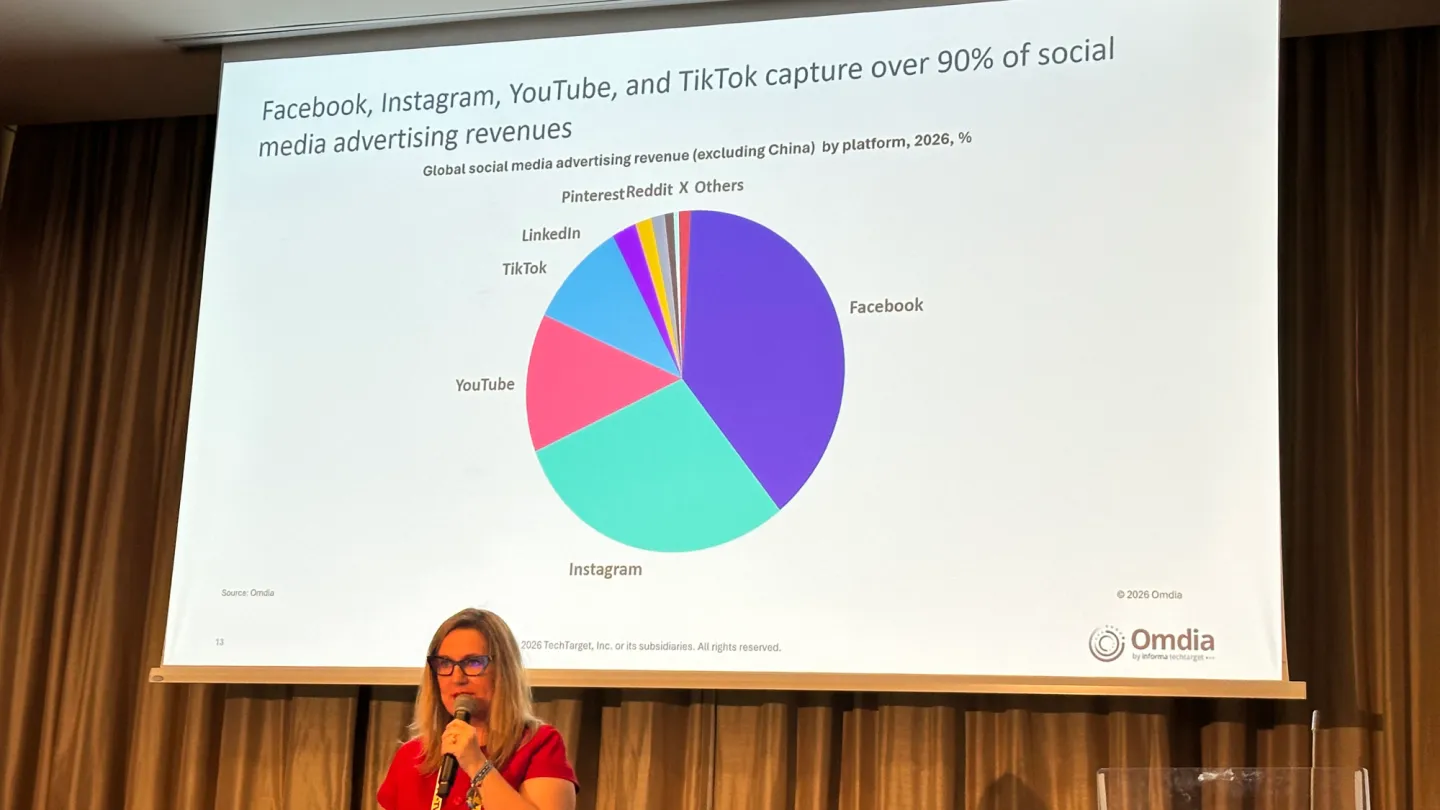
Omdia analysts explained that Facebook, Instagram, YouTube and TikTok “held more than 90 per cent of social media advertising revenues”. She also revealed that the Meta family alone, with Facebook and Instagram, accounted for 70 per cent of the total share of social advertising. According to Omdia, social video advertising will account for 40 per cent of global television and video revenues by 2030. At the same time, Agter stressed that “traditional broadcasters are losing their share of television/video revenues”. She also predicted that the revenues from online television advertising would exceed those from traditional television advertising in the 1930s. She noted that “the competitive dynamics of television advertising have completely changed”, with Amazon, Netflix and Google taking about 20 per cent of the market share. “Online television advertising is increasingly monopolized by these three companies”, Omdia predicts that by 2030, Amazon, Netflix and Google will account for 40 per cent of such advertising revenues.
In contrast, the share of traditional broadcasters will be only 25 per cent in 2030, down from 30 per cent in 2025 and 43 per cent in 2020, while the market share of networked television manufacturers and operating system operators, such as Samsung and Roku, will be only 10 per cent.